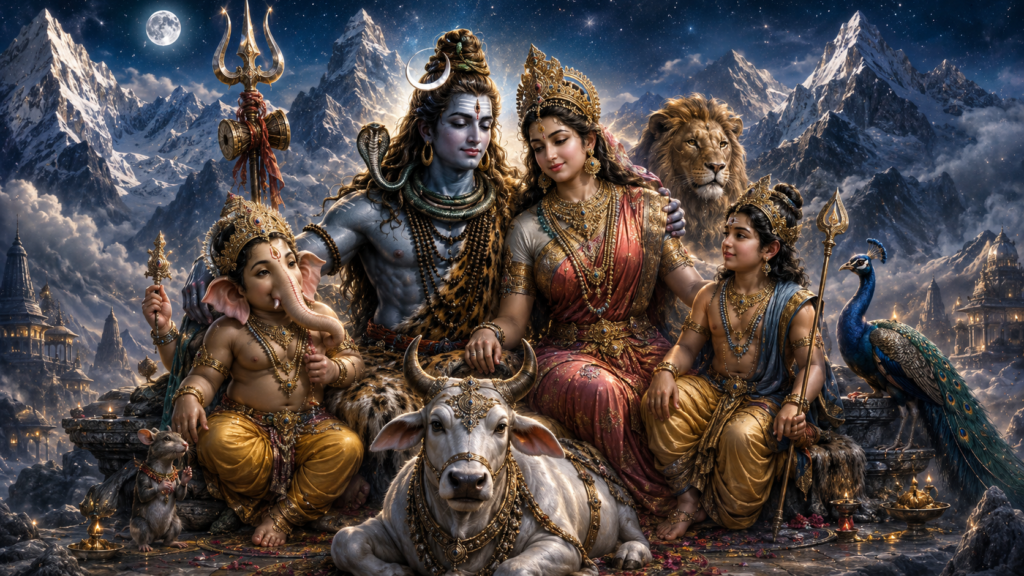
Shiva gets spoken of often, festival dates, puja steps, vrat (fasting) rules, and rarely described for what he actually is. Mahakaal, the one beyond time itself, the stillness the entire universe rests on.
This piece is an attempt to describe that scale directly, through the tales, the names, and what it actually means to call him Mahadeva.
Rudra, Who Became Mahadeva
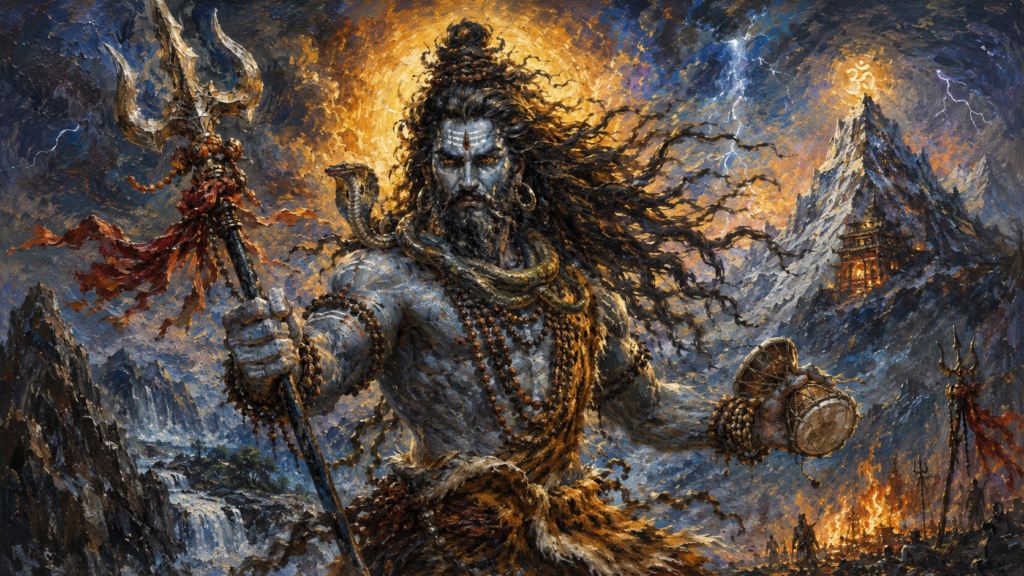
The oldest mention of Shiva is not as a gentle god. In the Rig Veda, he appears as Rudra, the fierce god of storm and destruction, a deity both feared and revered, the one who destroys falsehood, ignorance, and suffering, and grants wisdom in their place.
By the time of the Shvetashvatara Upanishad, composed roughly between 400 and 200 BCE, Rudra is no longer one god among many. He is named Mahadeva, the great god, and described as the creator of the cosmos and the one who liberates the self from the cycle of birth and rebirth.
Mahakaal, Beyond Time Itself
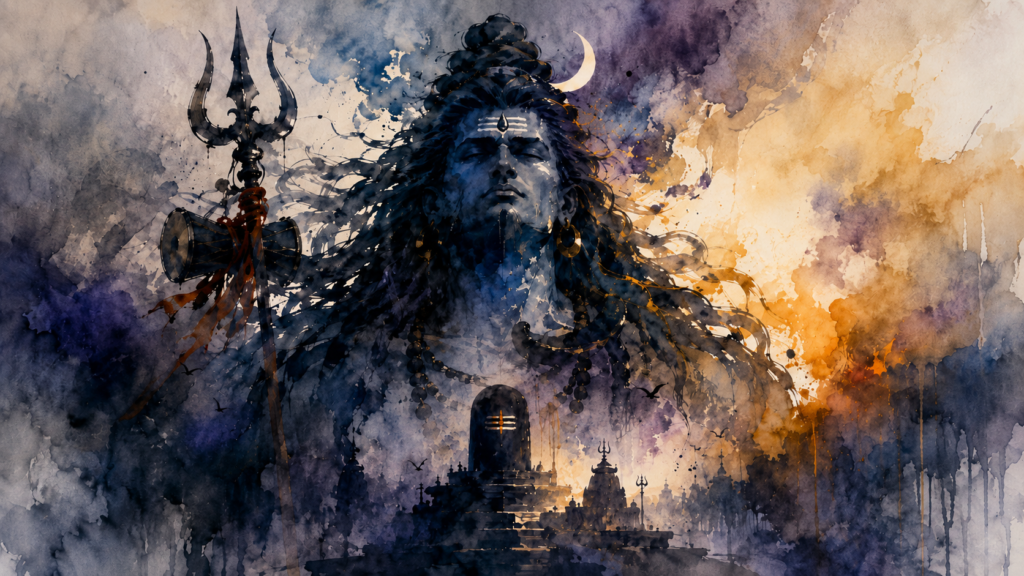
The name Mahakaal comes from “maha = great”, and “kaal = time or death“. It means the one who exists beyond both.
Everything else in creation is measured by time. It is born, it changes, and it ends. Mahakaal does not fit inside that measurement. He is described as the witness to the beginning, the middle, and the end of the universe, untouched by any of the three. Even Kaal, time and death personified, is said to fear him, which is the literal reason for the name.
This is not destruction for its own sake. It is what has to happen before renewal can happen. Whatever is bound by time eventually dissolves, including ego and attachment, and Mahakaal is the reality that remains standing after that dissolution.
The Poison He Chose to Keep
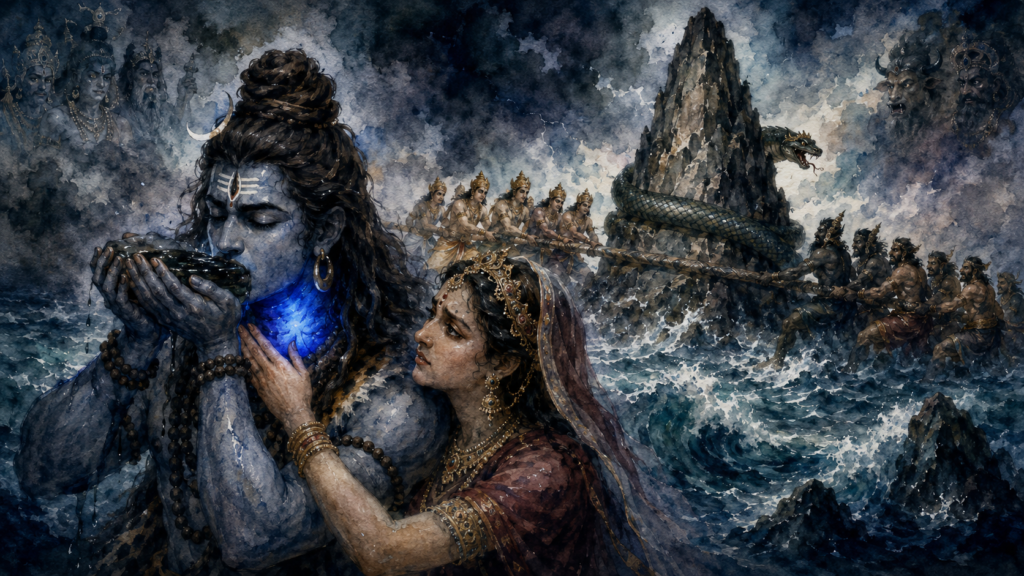
During the Samudra Manthan, when the devas and asuras churned the cosmic ocean in search of amrit, the poison Halahala rose from the waters before the nectar did. It was strong enough to end all of creation.
Shiva drank it. He held it in his throat rather than letting it pass further, and that is why his throat turned blue and he is called Neelkanth. Nobody else in the churning stepped forward for this. He absorbed what would have destroyed everyone else and asked nothing in return.
The Grief That Became a Dance
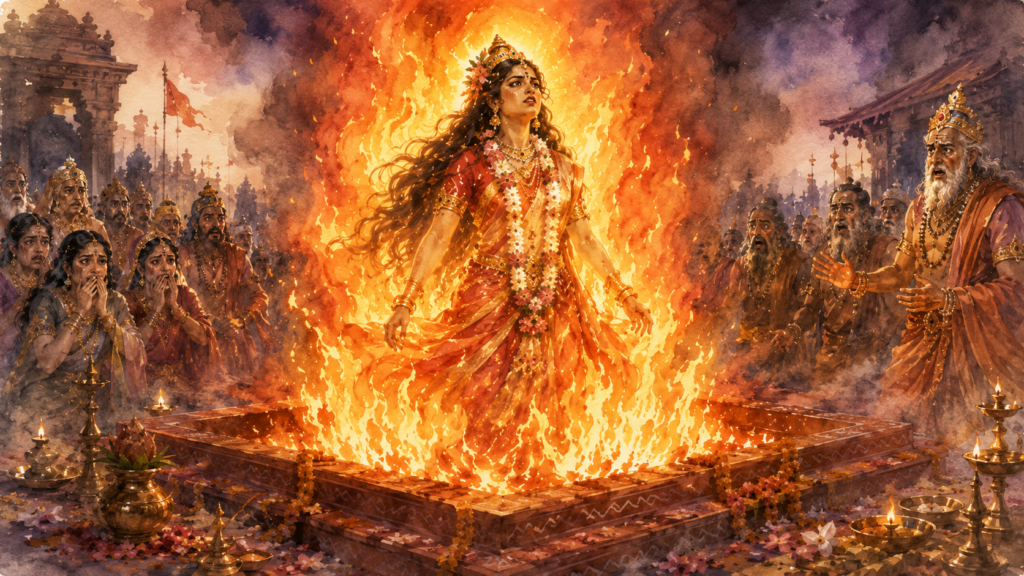
Sati, Shiva’s first wife, took her own life at her father Daksha’s yagna after Daksha insulted Shiva in front of everyone gathered there. When Shiva learned of it, his grief turned into Tandava, a dance so powerful it destabilized the universe itself.
Sati was later reborn as Parvati, daughter of the mountain king Himavan. She won Shiva back not through Daksha’s kind of power, but through her own tapasya, her penance. This is often the part of the story that gets skipped, but it matters. Shiva did not simply choose Parvati. She earned him back through her own discipline, and that is central to who she is in this story, not incidental to it.
The Eye That Answered an Arrow
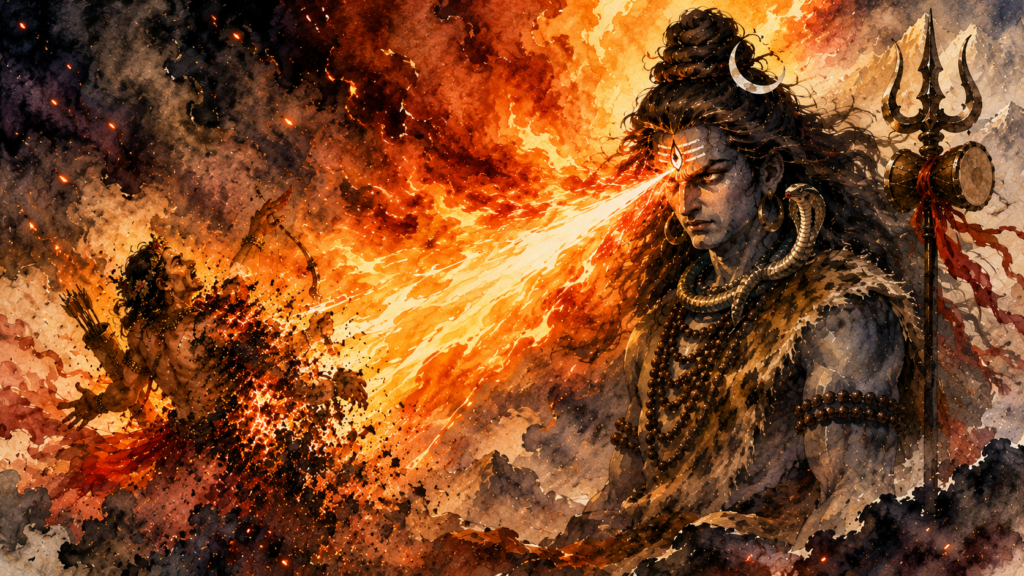
After Sati’s death, Shiva withdrew into meditation on Kailash, and his absence left the world without the energy it needed. Prophecy required a son born of Shiva to defeat the demon Tarakasura, which meant Shiva had to be drawn back toward life.
The devas sent Kamadeva, the god of love, to break his meditation. Kamadeva shot his arrow, Shiva’s eyes opened, and in his anger he opened his third eye and burned Kamadeva to ash on the spot. Kalidasa tells this story in the Kumarasambhava, one of the great works of classical Sanskrit poetry.
It is Parvati’s own penance afterward, not Kamadeva’s arrow, that finally reaches Shiva. Their union produces Kartikeya, who goes on to defeat Tarakasura as foretold. The lesson sits right there in the sequence. Desire could not move Mahadeva. Devotion did.
Shiva and Shakti, One Being in Two Halves
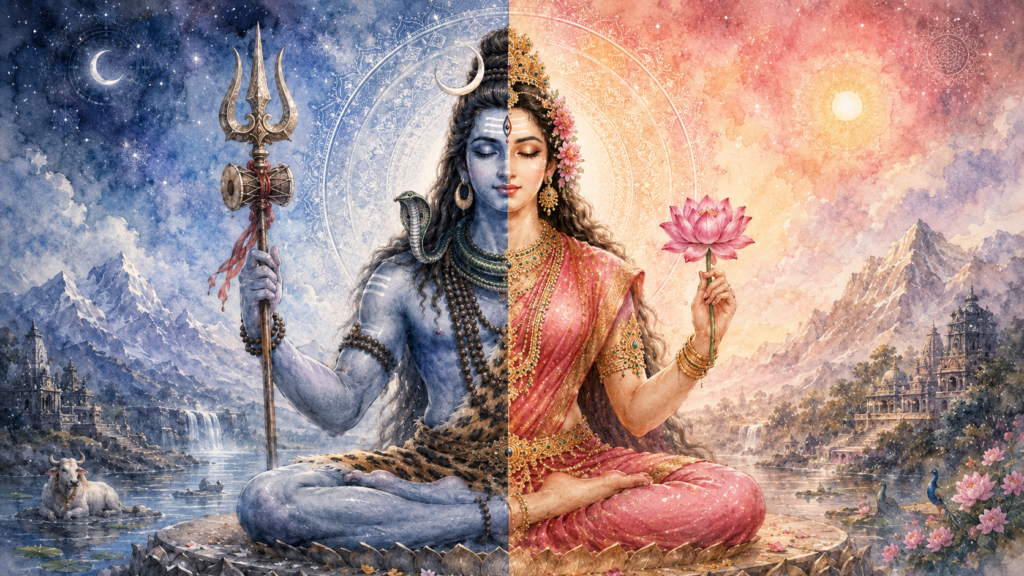
There is an old teaching in Sanskrit that if you remove the “i” from Shiva’s name, what remains is Shava, a corpse. That single vowel carries Shakti, and without her, Shiva is described as inert.
Shiva is consciousness at rest, awareness without motion. Shakti is the energy that moves, creates, and expresses. One without the other does not function. This is shown directly in the form of Ardhanarishvara, Shiva and Parvati fused into a single body, the right half Shiva and the left half Parvati, neither one placed above the other.
Parvati, Durga, Kali, these are not separate goddesses competing for space. They are understood as forms of the same Adi Shakti, the primordial energy, also called Prakriti, that activates Mahadeva’s stillness into the world we live in. When people speak of Aadi Shakti holding the universe together, this is the idea they are pointing to. Consciousness alone does not build a world. It needs Shakti to do that.
The Dance That Holds the Universe Together
Shiva’s most recognized form, Nataraja, shows him dancing the Tandava within a ring of fire. Under his raised foot lies Apasmara Purusha, the figure representing ignorance and forgetfulness, held down rather than destroyed outright.
The Ganga is shown flowing from his hair, a reference to Ganga Avatarana, the river’s descent from the heavens broken by his hair so the force of it would not shatter the earth. His two eyes are the sun and the moon. The third, the one that ended Kamadeva, represents the insight ordinary sight cannot reach. Taken together, the dance is not chaos. It is the visual of creation, preservation, and destruction happening at once, endlessly, with Mahakaal standing at the center of all three.
The Forms He Has Taken
Shiva does not stay confined to one form. The Shiva Purana names nineteen avatars he is said to have taken across the yugas, each one answering a need that a specific moment in creation called for.
Hanuman is the one most people already carry in their heart without realizing where he comes from. Widely held tradition describes him as Shiva’s own Rudra form, sometimes named the eleventh Rudra, born to Anjana through Vayu and sent to serve Rama with a devotion that needed no instruction. The strength, the fearlessness, the unbroken focus, all of it traces back to the same source this entire piece has been describing.
Virabhadra rose from a single strand of Shiva’s hair the moment Sati’s death reached him, sent to answer Daksha’s yagna the way that grief demanded.
Sharabha, part lion and part bird, is the form Shiva took to calm Narasimha’s fury after Hiranyakashipu fell, holding even Vishnu’s own incarnation back before order could return.
Ashwatthama, Drona’s son from the Mahabharata, is described in the Puranas as having been born from the same Halahala poison Shiva once swallowed at Samudra Manthan.
Bhairava came into being when Shiva had to answer Brahma’s arrogance directly, severing the fifth head that spoke out of pride, then carrying the weight of that act for years afterward in penance.
Even Nandi, the bull who sits facing every Shiva temple, is understood as Shiva’s own form standing guard, not a separate being entirely.
None of these forms replace the one before it. Each is Shiva meeting a moment that called for exactly that shape, then returning to Kailash once the moment had passed.
How He Is Approached
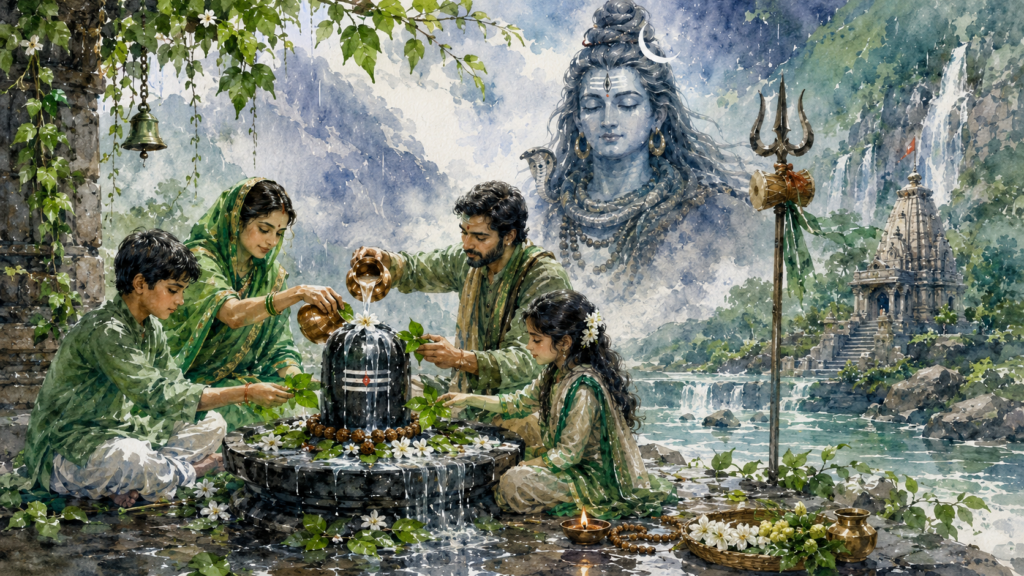
Devotees offer water, milk, bel patra to the Shivling, a practice rooted directly in cooling the same poison he once swallowed for everyone else. None of this worship asks for elaborate ritual. Water poured with attention, a name repeated with sincerity, that is the entire practice, because Shiva has never been a god who asked for more than sincerity.
Prayers, in the Words They Were Given
Rudra Gayatri Mantra
ॐ तत्पुरुषाय विद्महे महादेवाय धीमहि। तन्नो रुद्रः प्रचोदयात्॥
हम उस परम पुरुष को जानें, महादेव का ध्यान करें, वह रुद्र हमें सद्बुद्धि की ओर प्रेरित करें।
We seek to know the supreme being, we meditate upon Mahadeva, may that Rudra illumine and guide our minds.
Panchakshari Mantra
ॐ नमः शिवाय
मैं शिव को नमस्कार करता हूं, उस कल्याणकारी परम चेतना को प्रणाम।
Om, salutations to Shiva, the auspicious one. This is the five syllable mantra found within the Rudram, at the heart of the Vedas.
Maha Mrityunjaya Mantra
ॐ त्र्यम्बकं यजामहे सुगन्धिं पुष्टिवर्धनम्। उर्वारुकमिव बन्धनान्मृत्योर्मुक्षीय माऽमृतात्॥
हम त्रिनेत्रधारी शिव की पूजा करते हैं, जो सुगंध फैलाते हैं और सबका पोषण करते हैं। जैसे पका फल अपने डंठल के बंधन से सहज मुक्त हो जाता है, वैसे ही हमें मृत्यु से मुक्त कर अमरता की ओर ले चलें।
We worship the three eyed one, fragrant and the nourisher of all. As a ripe fruit falls freely from its stem, may we be freed from the bondage of death, and led toward immortality. This verse comes from the Rig Veda, 7.59.12, attributed to the sage Vasishtha.
Prayer to Aadi Shakti
सर्वमङ्गलमाङ्गल्ये शिवे सर्वार्थसाधिके। शरण्ये त्र्यम्बके गौरि नारायणि नमोऽस्तुते॥
हे सब मंगलों में परम मंगलमयी, कल्याणकारी, सबकी कामनाएं सिद्ध करने वाली, शरण देने वाली, त्रिनेत्रधारी गौरी नारायणी, आपको नमस्कार है।
To she who is the most auspicious among all things auspicious, the fulfiller of every purpose, the refuge of all who seek it, the three eyed Gauri Narayani, salutations to you. This verse is from the Devi Mahatmyam, and is addressed to the same Adi Shakti who stands beside Mahadeva as Parvati.
Supreme, Without Asking to Be Understood
Every name in this piece is a fragment of him, and not one of them is the whole. Mahakaal does not perform to be believed in. He does not wait for anyone’s argument or logic before he remains exactly what he already is, and he was that before this article and will stay that after it.
That is the whole of it, really. Not a case built from his stories, not a comparison weighed against any other supreme force. Just the pull itself, older and simpler than any reason anyone has ever given for it.